Rusty Lemon Handwritten Font for Small Business Branding
Two weeks ago, I sat at my kitchen table with a stack of blank candle labels, a half-finished Canva mockup, and that familiar “something’s off” feeling. My small-batch soy candles—hand-poured, locally scented, lovingly wrapped—were getting great feedback in person, but online? The visuals felt disjointed. My Instagram stories used one script font, my Etsy listing headers another, and the label on the jar itself was just a generic freebie I’d grabbed years ago. That’s when I searched “friendly handwritten font for small business” and found Rusty Lemon.
Rusty Lemon for Candle Labels and Handmade Product Packaging
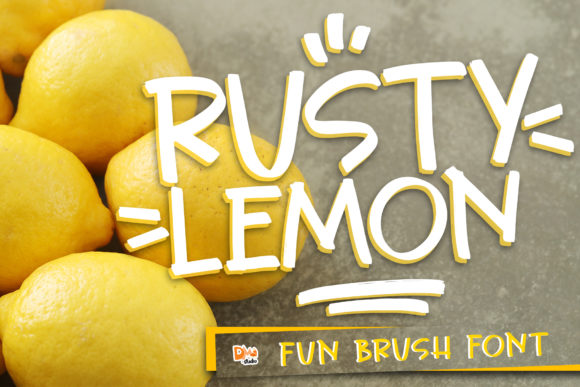
Rusty Lemon is a Script Handwritten font that feels like a warm, thoughtful note from a friend—not stiff, not overly ornate, just genuinely kind in its curves and spacing. As a small business owner who prints labels at home and ships hundreds of jars a month, I needed something that looked hand-done but stayed crisp at 10pt on a 2-inch label. Rusty Lemon delivers: it’s simple and neat, with open letterforms and gentle contrast—no thin hairlines that vanish in print or blur on matte sticker stock. I swapped it in for my candle scent names (“Honey & Sage,” “Rainy Window,” “Vanilla Cedar”) and instantly noticed how much more cohesive the whole line felt. Customers started tagging me in unboxings saying things like, “Your packaging looks so intentional.” It wasn’t magic—it was typography.
Rusty Lemon for Café Menus and Local Business Signage
If you run a neighborhood café, farmers’ market stall, or pop-up shop, you know how much weight your menu or chalkboard sign carries. It’s often the first thing people read—and the first impression they form. Rusty Lemon works beautifully as a display font for café menus because it’s legible at a glance yet full of character. I tested it alongside clean sans serif pairings (like Montserrat or Inter) for body text—Rusty Lemon for dish titles, sans serif for descriptions—and the balance felt effortless. No shouting, no fuss. Just warmth, clarity, and quiet confidence. And because Rusty Lemon is a well-structured Fonts file (OTF + TTF, with standard ligatures and alternate characters), it scales cleanly across digital menu boards, printed laminated cards, and even vinyl decals for window signage.
Rusty Lemon for Social Media Graphics and Instagram Story Templates
Let’s be real: scrolling past a flat, font-heavy Instagram story is easy. Standing out means marrying personality with readability—and Rusty Lemon nails both. As a Script Handwritten typeface, it adds instant charm to quote graphics, new product announcements, or limited-edition drops. I use it for short headlines only (“New Batch Live!” or “Just Restocked”), always over soft backgrounds or muted photos—never busy textures. Why? Because Rusty Lemon shines brightest when it has room to breathe. Its natural rhythm keeps things friendly, not frantic. Bonus: it renders cleanly on mobile screens, even in thumbnail previews. No pixelation, no awkward kerning. Just consistent, approachable energy—exactly what handmade and local brands need to feel human, not algorithmic.
Rusty Lemon for Wedding Invitations and Elegant Branding
You don’t have to be a wedding stationer to borrow elegance from this Fonts family—but if you are, Rusty Lemon is quietly brilliant for invitations, RSVP cards, and ceremony programs. It’s not fussy or formal; instead, it’s relaxed luxury—like linen napkins and wildflower bouquets. What makes Rusty Lemon work so well here is its natural flow: letters connect with ease, spacing feels intuitive, and the lowercase ‘g’, ‘y’, and ‘s’ have just enough personality without distracting. Paired with a light serif (think Playfair Display Light) for addresses or fine print, it creates hierarchy that feels intentional, not engineered. And yes—it’s fully licensed for commercial use, including physical print runs and digital templates you sell to clients.
Rusty Lemon for Thank-You Cards and Customer Touchpoints
The little things build trust. A handwritten-style thank-you card tucked into an order isn’t just nice—it signals care. But handwriting every card isn’t scalable. That’s where Rusty Lemon becomes part of your brand’s voice. I now use it for all printed thank-yous, return address stamps, and even the “P.S.” lines in my email newsletters. Because Rusty Lemon is a Script Handwritten font that’s both friendly and neat, it never feels robotic—even though it’s digital. Customers notice. One wrote, “Your note looked like it was written just for me.” That’s the power of choosing the right Fonts: it bridges the gap between handmade heart and professional polish.
Rusty Lemon for Online Shop Graphics and Digital Product Listings
Etsy, Shopify, and Amazon listings live or die by visual consistency. When shoppers see three different fonts across your banner, product title, and description preview, their brain subconsciously registers “amateur.” With Rusty Lemon, I unified everything: banner headlines, variant name tags (“Lavender | 8 oz | Soy Wax”), and even the “Add to Cart” button hover text (in a smaller size, paired with a friendly sans). It works because Rusty Lemon is designed for crafting design—it’s built for real-world use, not just display. Check your font files before downloading: Rusty Lemon includes OpenType features, multilingual support (great for gift shops with international buyers), and clear commercial licensing—so you can use it on merchandise, client projects, and digital downloads without second-guessing.
Rusty Lemon for Logo Design and Brand Identity Systems
Can Rusty Lemon be your primary logo font? Yes—if your brand voice is warm, grounded, and authentically small-scale. It’s not a bold monogram font, but it *is* memorable when used thoughtfully: think single-word logos (“Hearth,” “Grove,” “Meadow”), stacked wordmarks, or even monogrammed stickers. I tested it against my old logo (a rigid geometric sans) and realized how much more inviting the Script Handwritten version felt—especially next to photography of real hands, raw materials, or cozy spaces. Just remember: Rusty Lemon is best for short, meaningful words—not paragraphs. Let it lead, then step back and let clean supporting typography do the rest.