Bangga: A Script Handwritten Font for Elegant Brand Identity
It started with a blank mood board and a client email: “We’re opening a small ceramic studio—think handmade mugs, quiet mornings, and tactile textures. We want our branding to feel warm, intentional, and quietly luxurious.” No logo yet. No color palette locked in. Just that feeling—and the need for a typeface that could carry it. That’s when I opened my fonts folder and pulled up Bangga. Not as a last-minute flourish, but as a deliberate starting point.
Bangga for Wedding Invitations and Elegant Branding
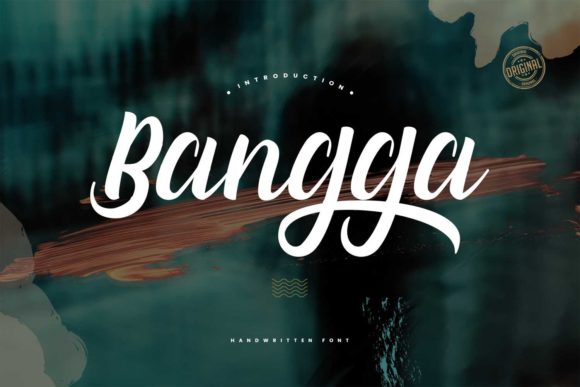
Bangga is a beautiful handwritten font, designed to flow easily—and that’s exactly what struck me first: its rhythm. Unlike some script fonts that feel overly ornate or stiff, Bangga moves like ink pulled gently across paper. The entry and exit strokes are soft but purposeful; the letterforms have subtle variation in weight and angle, giving them organic life. When I dropped it into a mockup for a wedding invitation suite (a side project I was testing alongside the ceramics brand), it didn’t just look pretty—it felt personal. Like someone had sat down and written each word with care. That same sincerity translated directly into the studio’s tone: not flashy, not trendy, but deeply human. For any creative business leaning into craftsmanship—ceramics, letterpress, botanical skincare, or even a neighborhood café—Bangga works as a quiet anchor of elegance.
Bangga as a Logo Font for Small Creative Businesses
I tested Bangga in three logo variations: full studio name in all caps, a stacked monogram, and a single-word mark (“Clay” in this case). It held up best in short-form applications—under 3–4 words—where its expressive curves could breathe. As a logo font, it’s not meant for dense paragraphs or tiny app icons. But on a shop sign? Gorgeous. On a matte-finish business card? Instant warmth. On a ceramic stamp pressed into packaging tape? Unmistakably handcrafted. Because Bangga is a beautiful handwritten font, it signals intentionality—not automation. That matters when your audience cares about who made it, not just what it is.
Bangga for Stationary Art and Printed Marketing Materials
One of the first things I printed was a set of letterpress-style thank-you cards using Bangga. Paired with a crisp serif (I used EB Garamond for body text), the contrast felt balanced—not competing, but conversing. Bangga shines in stationary art: envelopes, notecards, gift tags, even product labels where space allows for graceful, unhurried reading. Its versatility comes from how legible it stays at medium sizes (16–24pt) while still retaining personality. I avoided using it below 12pt—even with generous letter spacing—because the delicate connections between letters begin to blur. But for posters, event flyers, or Instagram story headers? Perfect. It catches the eye without shouting.
Bangga for Social Media Graphics and Digital Templates
Digital use required a little more nuance. On high-res screens, Bangga looks lush in hero banners and quote graphics—but I found it softened slightly on mobile previews. My fix? Slightly increased tracking (letter spacing) and a subtle drop shadow for contrast against light backgrounds. Since Bangga is a beautiful handwritten font, it thrives where visual texture matters: Instagram post headers, Pinterest pins, Canva templates for makers, or even animated website headlines. It doesn’t try to be neutral. It leans into being expressive—which is exactly why it stands out in feeds full of generic sans serifs.
Bangga Font Pairing with Serif and Sans Serif Fonts
Pairing Bangga is intuitive, not intimidating. With serif fonts (like Playfair Display or Lora), it gains gravitas—ideal for editorial design or luxury packaging. With clean sans serifs (Inter, Poppins, or Montserrat), it adds soul without clutter. I avoided pairing it with other script or handwritten fonts—too much motion, not enough grounding. And while Bangga has no built-in bold or italic weights (it’s a single-style Script Handwritten font), that limitation became a strength: it forced clarity in hierarchy. Headlines in Bangga. Everything else in a trusted workhorse. Simple. Effective.
Bangga for Product Labels and Handmade Packaging Design
The real test came with actual packaging: a set of reusable cotton tea bags, silk-screened with minimalist line art and stamped with the studio name. I placed Bangga on the label tag—curved gently along the bottom edge—and it transformed the piece. Suddenly, it wasn’t just functional; it felt like an artifact. Because Bangga is a beautiful handwritten font, designed to flow easily, it mimics the gesture of hand-lettering—something customers notice subconsciously. That emotional resonance? It’s hard to replicate with digital-only type. For handmade goods, artisanal food, or slow-living brands, Bangga delivers authenticity on demand.
Bangga Fonts Licensing and Commercial Use Considerations
Before finalizing anything, I double-checked the license—always do with Fonts you’ll use commercially. Bangga includes standard commercial licensing, meaning it’s cleared for client work, print runs, digital assets, and even merch. No hidden fees for extended use. It comes in OTF format (fully compatible with Adobe apps, Affinity, and modern design tools), with OpenType features like contextual alternates and ligatures—small touches that elevate consistency across longer phrases. There’s no multilingual support baked in, so if your brand targets non-English-speaking markets, keep that in mind. But for English-first branding—especially in lifestyle, wellness, or craft niches—it’s a polished, production-ready choice.
Bangga for Eye-Catching Editorial Design and Creative Projects
“Eye-catch” isn’t accidental—it’s engineered. And Bangga delivers it through contrast: fluid vs. static, organic vs. geometric, expressive vs. restrained. In editorial layouts—say, a seasonal lookbook or a zine for local artists—I used Bangga for pull quotes and section dividers. Never for body copy, but always where attention needed to land. Its personality does the heavy lifting, letting imagery and whitespace do the rest. That’s the power of a well-chosen Script Handwritten font: it doesn’t fill space—it defines tone.
If you’re designing for a brand that values craft over convenience, warmth over width, and authenticity over algorithm—Bangga isn’t just another font. It’s a quiet collaborator. One that asks you to slow down, choose words carefully, and let the letterforms do the speaking. And honestly? That’s rare.